How to Get to Coyoacan: Every Way In, Compared

How to get to Coyoacan trips up more visitors than you would expect, mostly because of one metro stop with a misleading name. The simplest route is Metro Line 3 to Viveros/Derechos Humanos, five MXN, followed by a fifteen-minute walk down Avenida Francisco Sosa into the plazas. I have watched visitors get off at the station actually named Coyoacan instead, on the wrong side of the neighbourhood entirely, and add twenty unscenic minutes to a trip that should have taken five. This guide is pure transport logistics: the metro route done right, honest Uber and Didi fares, why the full-day tour with transport included genuinely earns its price for some travelers, and what the cobblestones mean for strollers and wheelchairs once you arrive.
Quick answer
The simplest way to get to Coyoacan is Metro Line 3 southbound to Viveros/Derechos Humanos station, about 5 MXN and a fifteen-minute walk down Avenida Francisco Sosa into Jardín Centenario. Do not get off at the station literally named Coyoacan; it sits on Avenida Universidad, a dull twenty-to-twenty-five-minute walk from the historic center.
Key takeaways
- Correct stop: Viveros/Derechos Humanos, Line 3, not the station named Coyoacan
- Metro fare is a flat 5 MXN (~$0.29) regardless of distance or transfers
- Uber/Didi from Roma Norte or Condesa runs roughly 100-200 MXN, 25-40 minutes depending on traffic
- The return trip from the plazas is easy; cars circle Jardín Centenario and the mercado constantly
- The full-day tour bundles transport between Coyoacan, UNAM and Xochimilco, the honest case where a tour beats the metro
- Cobblestones make the historic core rough going for strollers and wheelchairs; the Viveros walk itself is flat but uneven
Which Route Fits You?
If have no car and are staying near the city center
take Metro Line 3 to Viveros, then walk.
If on a tight schedule with just one shot at the day
book the full-day tour with transport included.
If traveling as a group of 3 or more with a car available
drive and park near Jardín Centenario or the mercado.
If nervous about navigating transit in a new city
use Uber or Didi door to door; a few dollars buys the certainty.
Quick Comparison: All Ways to Get There
Every mode that genuinely exists for reaching Coyoacan, compared as of August 2026. Fares drift with fuel prices and traffic, so treat the cost column as a planning guide rather than a quote.
| Option | Time | Cost | Best for |
|---|---|---|---|
| Metro (Line 3 to Viveros) | 25-35 min from Hidalgo/Balderas + 15 min walk | 5 MXN (~$0.29) | No-car travelers comfortable walking the last mile |
| Uber / Didi | 25-40 min from Roma or Condesa | ~100-200 MXN (~$6-12) | Door-to-door without transfers |
| Metrobús + walk | Similar to metro, one more transfer | 6 MXN (~$0.35) | Travelers already near a Metrobús line |
| Tour with hotel pickup and transport | Pickup around 8:00-9:00, zero navigation | From $51, transport bundled with Xochimilco and UNAM | First visits, one-shot schedules, no interest in transit |
Our own pick for independent travelers is the metro to Viveros, because the fare is trivial and the walk down Francisco Sosa is genuinely one of the nicest fifteen minutes you will spend in Mexico City. Everything below unpacks each row.
Where Exactly Is Coyoacan?
The historic core sits south of the city center. Viveros/Derechos Humanos is the correct Line 3 stop; the station literally named Coyoacan sits further east on Avenida Universidad and is not the shortcut its name implies.
By Metro: Line 3 to Viveros, Step by Step
Board Line 3 (olive green, Indios Verdes to Universidad) heading south, from any central station such as Hidalgo or Balderas. The ride to Viveros/Derechos Humanos runs roughly 25 to 35 minutes depending on where you board. Fare is a flat 5 MXN (about $0.29) regardless of distance or transfers, and a rechargeable Movilidad Integrada card costs 15 MXN at the station windows if you do not already have one.
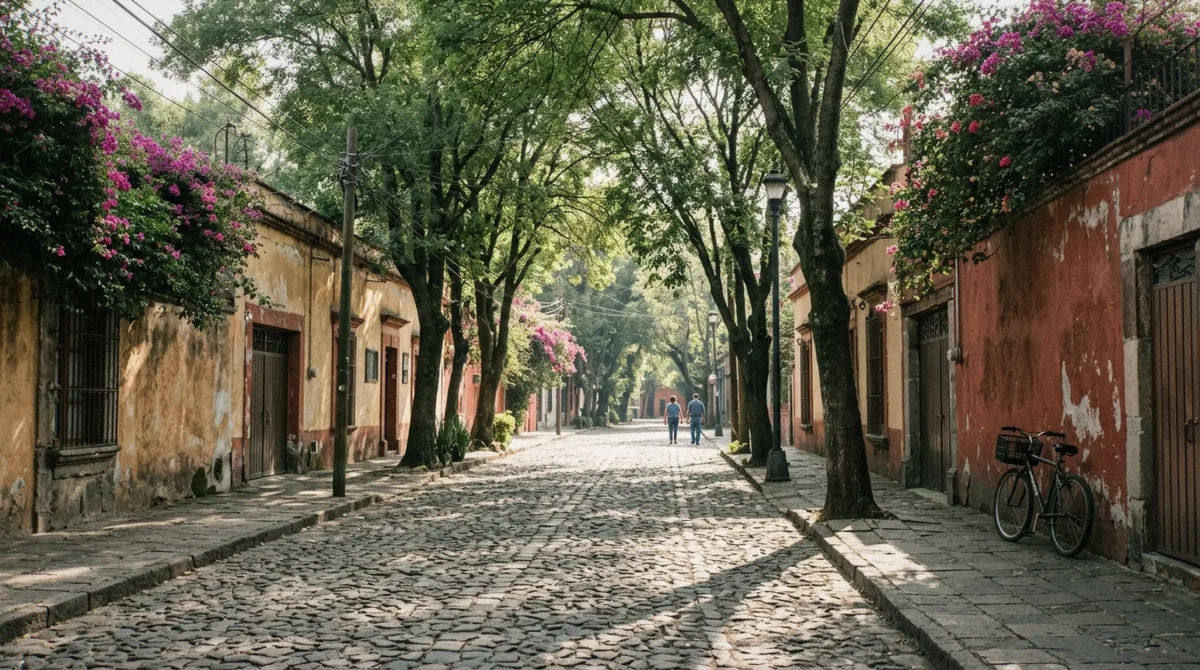
Exit Viveros station on the south side and head east along Avenida Progreso. After a few minutes you reach Plaza Santa Catarina, a small square that is worth a pause even though it is not the main event, then continue onto Avenida Francisco Sosa, which carries you directly into Jardín Centenario. The whole last mile takes about fifteen minutes and is, in my opinion, the prettiest walk into any neighbourhood center in Mexico City: cobblestones, colonial facades, jacaranda trees in season.
Metro rush hours run roughly 7:30 to 9:30 and 18:00 to 20:00 on weekdays; the crush is real and the cars marked for women and children sit at the front of the platform if that matters to you.
Why NOT the "Coyoacán" Metro Station
This is the trap that catches nearly every first-timer, and it is worth naming plainly. Line 3 has a station literally called Coyoacán, sitting on Avenida Universidad, and the name makes it feel like the obvious choice. It is not. From that station, the walk to the historic center runs 20 to 25 minutes along a stretch of Universidad that has none of the charm of Francisco Sosa, more traffic, and no reason to linger.
Viveros/Derechos Humanos is the stop you actually want, even though its name gives no hint that it serves Coyoacan's plazas at all. If you are coming from the Zócalo side of the city and would rather skip a transfer, Line 2 to General Anaya works as an alternate, with a similar 15-to-20-minute walk west into the neighbourhood.
By Uber / Didi
Both apps operate reliably across the neighbourhoods most visitors stay in, and drivers know Jardín Centenario and the mercado by name as drop-off points. From Roma Norte or Condesa, expect roughly 100 to 200 MXN (about $6 to $12) for an UberX, checked against current fare reports in August 2026, with the ride itself taking 25 to 40 minutes depending on traffic. Prices climb during weekday evening rush, Friday and Saturday nights, and rain, sometimes noticeably.
The return trip is easy, which is not always true elsewhere in the city. Cars circle the plazas and the mercado constantly through the afternoon and evening, so requesting a pickup from either spot rarely takes long. Name Jardín Centenario or the mercado as your pin rather than a side street; both are landmarks drivers recognize instantly.
From Roma / Condesa specifically
This is the most common origin for visitors staying in the trendier northern neighbourhoods, and the trip runs 25 to 40 minutes by rideshare depending on which streets are backed up. Traffic on the connecting avenues, particularly Insurgentes and the Viaducto, is the variable that swings the estimate; leaving before 9:00 or after 20:00 keeps you toward the shorter end.
The Zero-Hassle Option: Tours with Transport
Every DIY mode above shares one limitation: it gets you to Coyoacan and nowhere else, which is fine if Coyoacan is your whole day but a hassle if you are also trying to reach Xochimilco and UNAM. The full-day Xochimilco, Coyoacán and Frida Kahlo tour handles transport between all three stops, with hotel pickup and a vehicle that stays with you the entire day, at $51 per person.
The honest trade-off: if Coyoacan alone is the plan, the metro or a rideshare gets you there for a fraction of that price. Where the tour earns its cost is stitching together a multi-stop day without you having to plan three separate legs of transport, or worrying about the last bus back from Xochimilco's canals.
For a stop-by-stop account of what that day actually covers, canals included, read our review of the Xochimilco, Coyoacán and Frida Kahlo tour.
Getting Around Once You're There
Everything in the historic core is walkable. Casa Azul (Londres 247) sits about ten minutes on foot north of Jardin Centenario and Jardín Hidalgo, the León Trotsky House Museum on Av. Río Churubusco a further fifteen minutes past that, and the mercado is two blocks from the main plazas in the other direction.
No transit or rideshare is needed to move between any of these once you have arrived; the whole route is a leisurely walk of well under an hour end to end. Rideshare drivers know Jardin Centenario or the mercado by name as drop-off pins, better landmarks than a side-street address.
Accessibility, Strollers and Cobblestones
The historic core is genuinely rough going for wheels. Cobblestones cover most of the plazas and the streets around them, with uneven surfaces and occasional high curbs that make wheelchairs and strollers hard work, something few guides mention outright. The Viveros walk itself is a mixed picture: mostly flat, paved sidewalk, but with the same uneven cobblestone stretches once you reach Francisco Sosa's older blocks near the plazas.
If mobility is a concern, a rideshare or the tour vehicle can drop closer to Jardín Centenario itself rather than relying on the full Viveros walk, cutting the roughest stretch of pavement out of your day.
Whichever way you choose, no route into Coyoacan is genuinely hard. For a no-car traveler on a normal schedule, the metro to Viveros wins on price and gives you that Francisco Sosa walk as a bonus rather than a chore. For a tight one-shot day, or a plan that also covers Xochimilco and UNAM, the tours of Coyoacán with transport included we track handle every leg without you thinking about it.
If you are still deciding whether to bring a guide at all once you arrive, our full Coyoacan without a tour breakdown covers what a self-guided day costs and where a tour genuinely earns its price. And if your day is likely to run past sunset, read is Coyoacan safe at night before you plan the return leg.
Frequently Asked Questions
Which metro station do I use to get to Coyoacan?
Viveros/Derechos Humanos on Line 3, not the station literally named Coyoacan. From Viveros, walk east on Avenida Progreso, through Plaza Santa Catarina, and onto Avenida Francisco Sosa into the plazas, about fifteen minutes total.
How much does a taxi or Uber to Coyoacan cost?
From Roma Norte or Condesa, expect roughly 100 to 200 MXN (about $6 to $12) for an UberX, checked in August 2026, with fares rising during evening rush, weekend nights and rain.
Is there a direct bus to Coyoacan?
Metrobús lines reach the general area with one additional walk beyond the stop, similar in total time to the metro route. There is no single direct bus that drops you at the plazas themselves.
How long does it take to get to Coyoacan from central Mexico City?
By metro, about 25 to 35 minutes to Viveros plus a 15-minute walk. By rideshare from Roma or Condesa, 25 to 40 minutes depending on traffic. Tours with pickup add collection time from your hotel on top.
Can I get a rideshare back from the plazas easily?
Yes. Jardín Centenario and the mercado are both landmarks drivers recognize instantly, and pickups are reliable through the afternoon and evening.
Is Coyoacan wheelchair or stroller accessible?
The historic core is genuinely rough: cobblestones and uneven curbs cover most of the plazas and surrounding streets. A rideshare or tour drop-off close to Jardín Centenario avoids the roughest stretch of the Viveros walk, but the plazas themselves stay uneven underfoot.
Does the full-day tour handle transport to Xochimilco too?
Yes. The full-day combo tour covers Coyoacan, UNAM and Xochimilco with hotel pickup and a vehicle for the whole day, which is where it genuinely beats stitching together separate metro and rideshare legs.